Can artificial intelligence help detect contaminants in water?
July 6, 2026
Antibiotic residues are now commonly found in rivers, groundwater, and other water bodies, raising concerns for human, animal, and environmental health. Detecting these contaminants quickly and reliably is essential. To help identify trace amounts of antibiotics, researchers are increasingly turning to artificial intelligence (AI); however, training these models often requires large datasets that are simply not available.
Researchers at the INL have developed a new AI approach that addresses this challenge by generating realistic synthetic data to improve the detection of antibiotic residues in water. The work, recently published in Chemical Engineering Journal Advances, was carried out by INL researchers Diogo Cachetas, Ensieh Iranmehr, Ana Vieira, João Rodrigues, under the supervision of Laura Rodriguez-Lorenzo, from Espiña’s research group, in collaboration with the University of Minho.
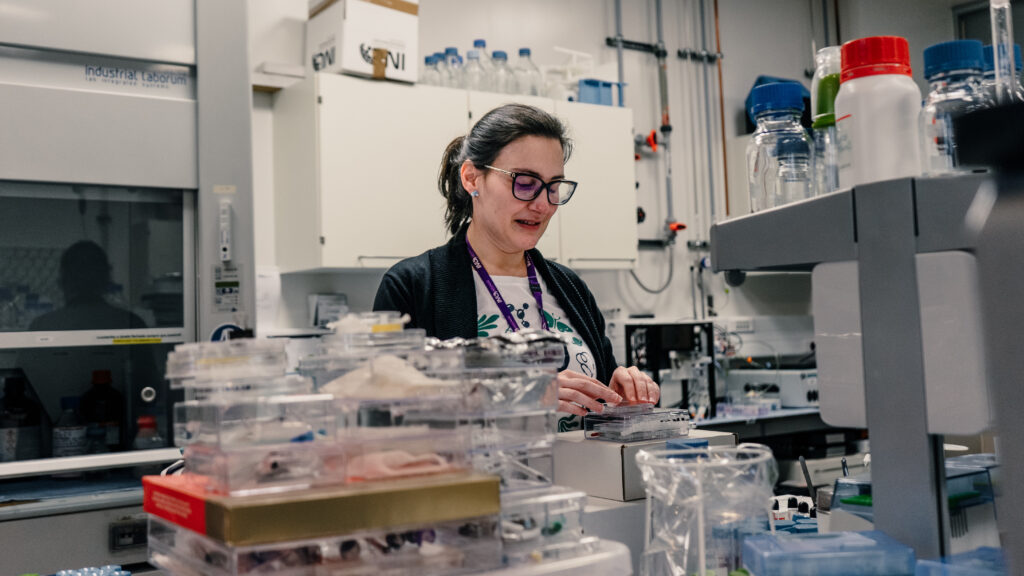
The study focused on sulfonamides, one of the most frequently detected families of antibiotics in water environments. The researchers combined surface-enhanced Raman scattering (SERS), a highly sensitive spectroscopic technique capable of detecting low concentrations of molecules, with an advanced deep-learning framework that generates realistic synthetic spectra.
By increasing the limited experimental dataset with synthetic data, the classification model becomes better at recognising different antibiotics in water samples. The new approach significantly improves specificity, meaning it becomes much more reliable at distinguishing target contaminants from non-target signals and reducing false positives.
Laura Rodriguez-Lorenzo explains, “The generated data preserved the characteristics of real spectra and improved the performance of several machine learning models, demonstrating that synthetic data can effectively compensate for data scarcity in spectroscopic applications.”

This research work, supported by Fundação para a Ciência e Tecnologia (FCT), and by the SMARTgNOSTICS project under the Portuguese Recovery and Resilience Plan (NextGenerationEU Fund), shows how generative AI can help overcome data limitations, and make the detection of antibiotic residues in water more reliable.
Spotlight by Catarina Moura, Clara Miranda, and Rui Andrade
See how we are sharing this breakthrough on LinkedIn, Facebook, Instagram & Bluesky!