News

Pioneering Nanomaterials for Energy and Sensing: Symposium Announced for EMRS 2025 Fall Meeting

Pioneering Nanomaterials for Energy and Sensing: Symposium Announced for EMRS 2025 Fall Meeting

The symposium titled “Nanomaterials of the Future – Advancements in Energy and Sensing”, which will be part of the 2025 Fall Meeting of the European Materials Research Society (E-MRS), will take place from September 15–18, 2025, at the University of Technology in Warsaw, Poland. Co-chaired by an esteemed international team of researchers, the event will spotlight the latest breakthroughs in nanomaterials science and their transformative applications in energy, photonics and sensing technologies. Along with Pedro Salomé, the team leader of Salomé research group at INL, the organizing committee includes Maria Josè Lo Faro from Physics Department “Ettore Majorana” of University of Catania and Maria Caterina Giordano from Physics Department of Università degli Studi di Genova, both in Italy, and Sabrina Sartori from Department of Technology Systems of University of Oslo in Norway. “The EMRS meetings are among the most important events in materials science in Europe and this symposium will help to strengthen collaborations in the areas of nanomaterials for energy applications” said Pedro Salomé, underlining the relevance of the event for Europe’s innovation landscape. The symposium will bring together leading scientists, early-career researchers, and technologists to explore advancements in growth techniques, nanofabrication and computational modelling of nanomaterials that exhibit exceptional physical and chemical properties. The ultimate goal: unlocking their […]

Read more
Graphene-based biosensor breaks detection records for non-invasive monitoring of diabetes

Graphene-based biosensor breaks detection records for non-invasive monitoring of diabetes

A breakthrough biosensor detects glucose in human tears at ultra-low concentrations, opening new avenues for wearable health monitoring technologies. In a significant leap toward the future of diabetes care, INL researchers have developed a graphene-based biosensor capable of detecting glucose at attomolar levels—representing the lowest detection limits ever achieved for this crucial biomarker. It’s comparable to finding a single grain of sugar dissolved in an entire lake. The study, published in the Journal of the American Chemical Society and led by Dr. Andrea Capasso at INL, introduces an ultra-sensitive glucose sensor based on graphene field-effect transistor (GFET) technology. Engineered to operate with extremely small volumes of biological fluid – down to a single tear -, this device has the potential to revolutionise glucose monitoring, particularly in non-invasive and wearable systems. The researchers developed a targeted graphene functionalisation using glucose oxidase (GOx), enabling highly selective glucose recognition. They then employed advanced spectroscopic and microscopic techniques to analyse the graphene’s chemical composition and surface modifications at each stage of functionalisation, from enzyme immobilisation to interaction with the target analyte. “While finger-prick sensors remain the clinical standard for diabetes monitoring, they are often perceived as uncomfortable and invasive,” says Dr. Capasso. “Our goal […]

Read more
No assumptions: just quantum advantage

No assumptions: just quantum advantage

INL researcher Michael de Oliveira, together with collaborators from the University of Cambridge and the Hon Hai (Foxconn) Quantum Computing Research Center, has published a new article in Nature Communications demonstrating that even small, noisy quantum circuits can outperform certain types of classical computation, without relying on assumptions or ideal conditions. This study focuses on constant-depth quantum circuits, meaning that all operations happen in parallel in a very short time – like multiple people completing a task simultaneously rather than one after another. The researchers show that these simple quantum circuits can solve specific problems that no classical circuit of the same kind and size can solve, even when those classical circuits are modelled after neural networks, with tuneable flexibility. The classical models studied here (biased threshold circuits) are used in theoretical models of machine learning and resemble basic neural networks. Despite the authors considering versions with low bias – and therefore greater versatility – they are still outperformed by shallow quantum circuits, even when the quantum devices are noisy or imperfect. What makes this breakthrough particularly important is that it applies to qudits (quantum systems that go beyond binary bits or qubits), and the results are valid across all […]

Read more
Advancing neuronal research using 3D polymeric micro-scaffolds integrated with quantum sensors

Advancing neuronal research using 3D polymeric micro-scaffolds integrated with quantum sensors

A recent research study from INL has successfully merged two cutting-edge 3D tissue engineering strategies – 3D polymeric scaffolds and 3D neuronal spheroids – to create a highly advanced model for studying neuronal behaviour and disease. The collaboration between biomedical engineers, physicists, and neuroscientists has led to the development of a smart polymeric scaffold integrated with fluorescent nanodiamonds, that reveals to be a powerful quantum sensing tool. These low auto-fluorescence scaffolds, fabricated using laser-based 3D microprinting, were designed to be both biocompatible and capable of hosting 3D neuronal spheroids. The fluorescent nanodiamonds embedded within the scaffolds provide the potential for real-time monitoring of magnetic signals and temperature shifts at the nanoscale, providing a new level of precision in studying cellular signalling, disease mechanisms, and drug responses. Beatriz Costa, the first author of this study, emphasises the significance of the work: “The use of low-autofluorescence 3D polymeric scaffolds enabled the integration of quantum metrology techniques with nanodiamonds. When combined with 3D neuronal cell aggregates, this approach holds great potential for in-depth studies of neurodegenerative diseases and beyond.” The study’s success lies in its ability to use these scaffolds to host dopaminergic neurons, crucial to Parkinson’s disease research, and demonstrate the neurons’ […]

Read more
INL Hosts IDEAL Cluster Annual Meeting in Portugal

INL Hosts IDEAL Cluster Annual Meeting in Portugal

The IDEAL Cluster for Indoor Air Quality and Health held its second Annual Meeting on March 25-26, 2025, in Braga, Portugal. The event aimed to enhance synergies and amplify the impact of various Horizon Europe projects focused on indoor air quality and health. This year’s meeting was hosted by the LEARN project at the International Iberian Nanotechnology Laboratory (INL), which coordinates the IDEAL Cluster from September 2024 to April 2025. The event saw the participation of around 50 researchers and R&I professionals representing seven projects and eight working groups, with additional attendees joining online. Among the on-site participants were 10 members from LEARN project partner organizations, including INL, FI Group, VUB, TU/e, MANN+HUMMEL, and NIA. They presented their advancements in air pollution sensors, in-vitro models, skin-on-a-chip, and multi-sensing approaches, along with preliminary results from cohorts at Belgian schools and notable communication activities. Key discussions and presentations covered policy recommendations on indoor air quality, data exchange practices, communication collaborations, innovative sensor developments, guidelines and standardisation efforts, and the potential creation of a global indoor air quality index. The European Commission was represented by project officer Rita Araújo from the DG for Research and Innovation, Marco Morini from the DG for Energy, […]

Read more
Rui Campos Advances Biosensor Research at INL

Rui Campos Advances Biosensor Research at INL

Rui Campos, working in the Diéguez Research Group at INL – International Iberian Nanotechnology Laboratory since October 2024, is developing a biosensor for continuous detection of inflammation biomarkers as part of the WINGS project funded by the La Caixa Foundation – Health Research Programme. His research focuses on bioelectrochemical assays for detecting nucleic acids, proteins, and small molecules. Dr. Campos earned his Ph.D. in Chemistry from Durham University (UK) in 2013. He has conducted postdoctoral research at Aarhus University (Denmark), INL (Portugal), and the University of Antwerp (Belgium), where he developed a biosensor for prostate cancer microRNAs under the Marie Skłodowska-Curie Actions fellowship. In this interview, Dr. Campos shares his journey in biosensor research, contributions to the WINGS project, and advice for young researchers in nanotechnology and biomedical applications. What drew you to biosensor research, and how has your journey across different institutions shaped your expertise? My interest in biosensor research was sparked by the potential to create innovative solutions for real-world problems, particularly in healthcare. The ability to develop devices that can detect and monitor biological markers with high sensitivity and specificity is incredibly exciting.My journey across different institutions has been instrumental in shaping my expertise. At Durham, UK, […]

Read more
INL’s 3MT competition is back: showcasing PhD research in just 3 minutes

INL’s 3MT competition is back: showcasing PhD research in just 3 minutes

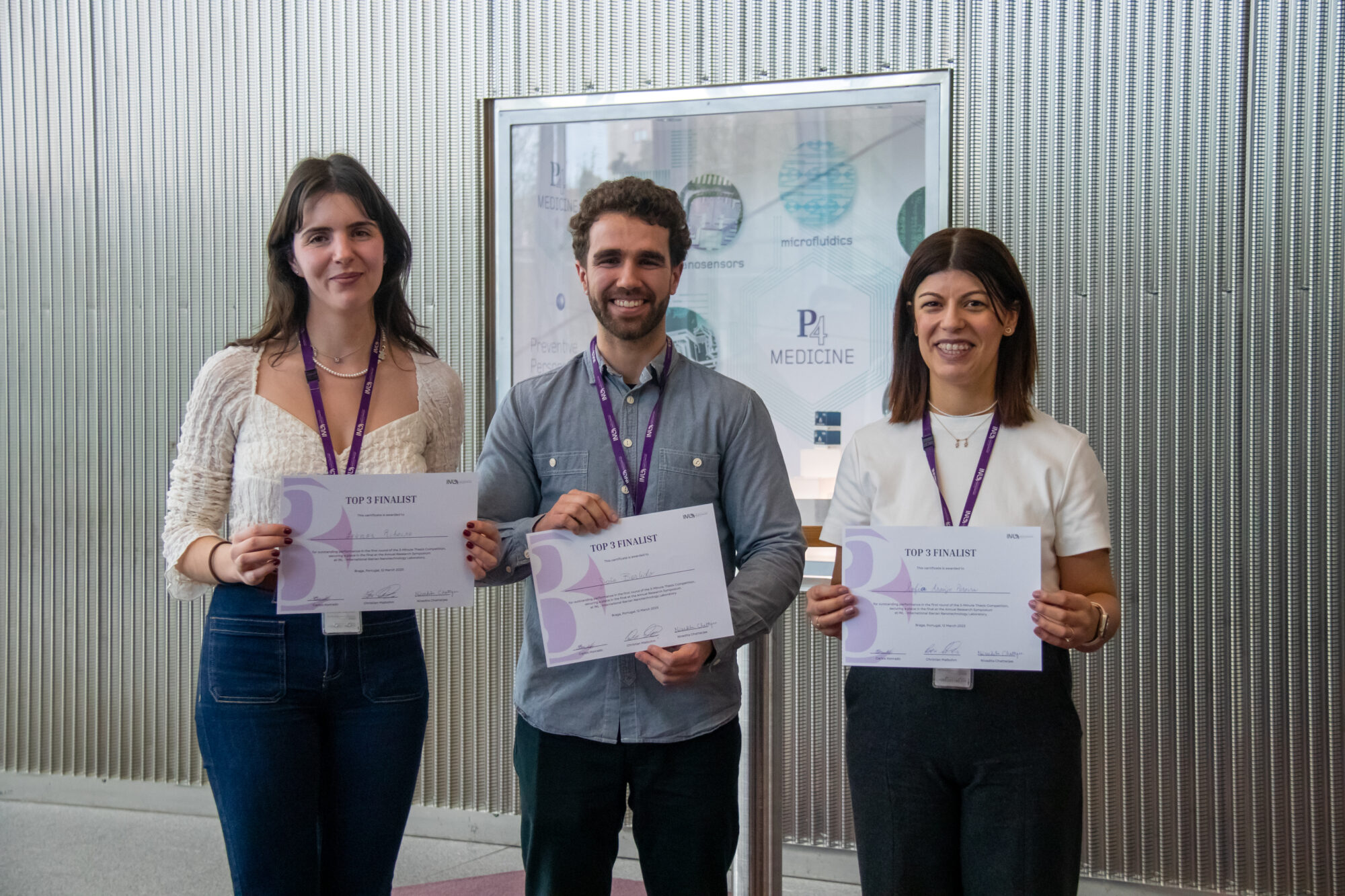
On March 12, INL hosted the second edition of its Three Minute Thesis (3MT) competition, bringing together eight PhD candidates eager to share their research in an engaging and accessible format. With a fantastic round of presentations, the challenge was intense: simplify complex research into a compelling three-minute talk for a non-specialist audience. The competition highlighted INL’s commitment to fostering strong science communication skills among early-stage researchers. Participants took the stage to captivate the audience and jury, demonstrating not only their expertise but also their ability to make cutting-edge science approachable and impactful. After an exciting session, three outstanding presentations stood out. Leonor Ribeiro, a second-year PhD candidate in Nieder group, presented her work on a novel nanoparticle for combined photodynamic and immunotherapy of lung cancer. Leonor shared, “Summarising a PhD thesis in just three minutes is challenging but valuable to learn how to communicate your own research clearly and engagingly. I highly recommend it to any student feeling stuck in their work, as it can reignite their enthusiasm.” João Borlido, a second-year PhD candidate in iMiNa group, focused on the role of metasurfaces in high-performance CMOS image sensors for automotive applications. Looking back on the challenge of summarising his […]

Read more
Navigating Scientific Frontiers: An Interview with Rajashree Konar

Navigating Scientific Frontiers: An Interview with Rajashree Konar

In this insightful interview, Dr. Rajashree Konar, a Postdoctoral Researcher at INL, shares her experiences working in diverse international research environments and how they have shaped her scientific approach. She discusses her contributions to sustainable energy solutions, particularly through her work on nanocatalysts and lithium-ion batteries. Dr. Konar also offers valuable advice for researchers looking to patent their work and translate their research into real-world applications. Additionally, she candidly addresses the challenges she has faced as a woman in a highly technical field and the importance of female support networks in overcoming these obstacles. You have worked in multiple international research environments. How have these experiences shaped your scientific approach?In-depth research always demands consistent hard work. My experiences abroad have instilled in me a profound sense of persistence. Working in science and research can often feel like a slow march forward, demanding unwavering faith. But, through my multicultural journey, I have discovered that all scientists share an intense passion for growth, refusing to be confined by limitations. Each person, lab, culture, and university I’ve engaged with has taught me that collaboration is the key to truly understanding our work and harmonising our outlook. My exposure to a vibrant tapestry of […]

Read more
Taking inspiration from the human brain to create a new class of intelligent, light-powered devices

Taking inspiration from the human brain to create a new class of intelligent, light-powered devices

At INL, our researchers are pushing the boundaries of brain-inspired computing, developing neuromorphic systems that process sensory data the way nature does – fast, efficiently, and with minimal energy. In a recently published paper in Scientific Reports, INL researchers developed a tiny micropillar quantum resonant tunnelling diode, or RTD, that behaves like a sensory neuron. This ‘neuron’ is capable of detecting light, processing information, and converting it into electrical signals, all within a single nanoscale device. Researcher Bruno Romeira explains, “This is possible because we are using quantum phenomena.” At its core, this system is a III–V semiconductor structure (materials widely used in photonics and high-speed electronics) designed to respond directly to incoming near-infrared light. When the light intensity reaches a certain threshold, the device enters a state known as negative differential resistance, triggering large-amplitude voltage oscillations. In other words, the incoming light signal is transformed into rhythmic electrical bursts, just like the firing patterns seen in biological neurons. Traditional neuromorphic hardware often relies on complex circuits, combining separate memory components and oscillators to mimic the way biological neurons process information. This increases the size, power consumption, and complexity of the system. The new device developed by Bejoys Jacob and […]

Read more
1 2 3 4 70